
Introduction: When Your Portfolio Suddenly Turns Red
You open your trading app during lunch break.
Your portfolio — red.
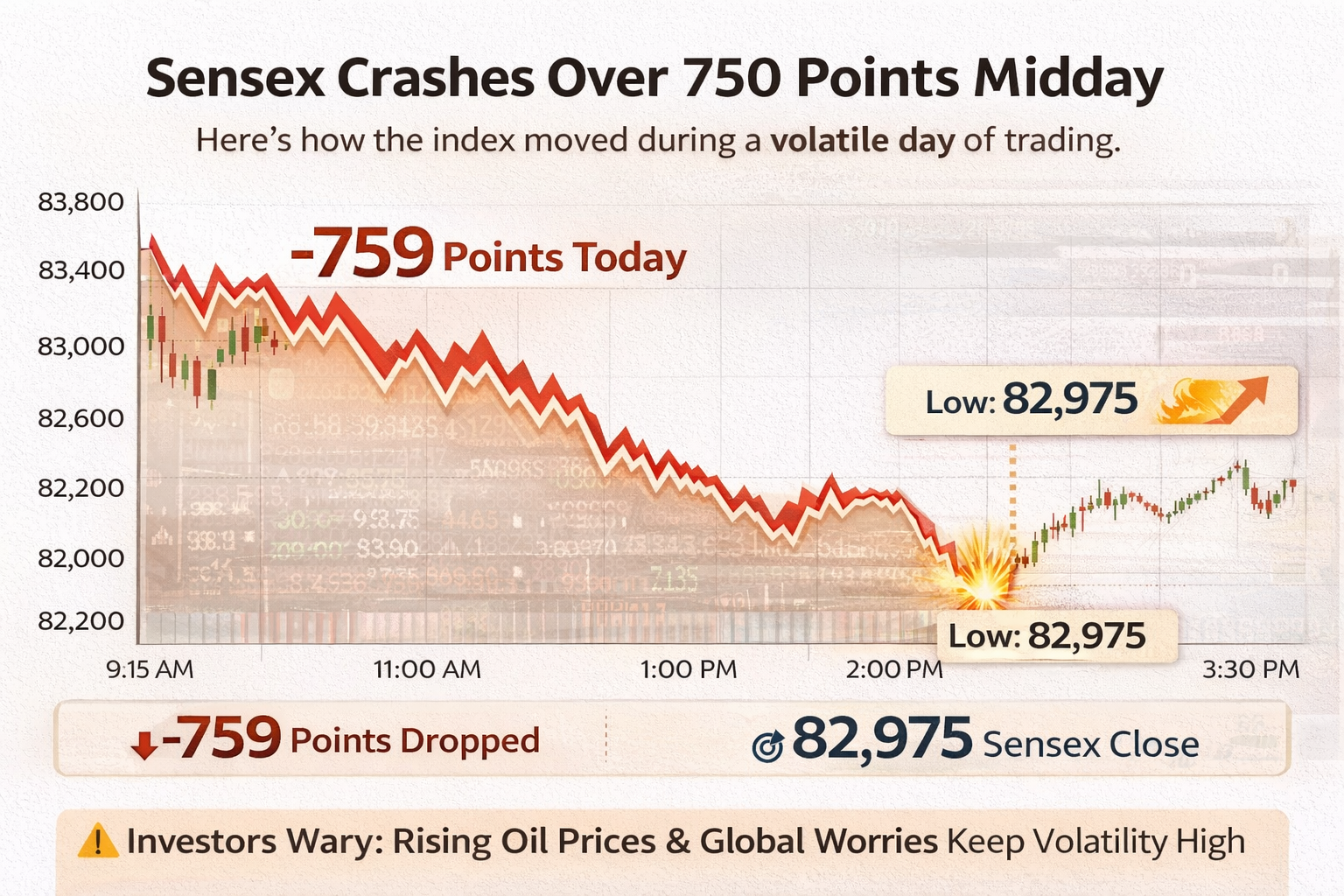
Sensex down 700+ points.
Nifty below 25,600.
Your first thought?
“Should I sell? Is this the start of a bigger crash?”
If you felt that anxiety today, you’re not alone.
In this detailed guide, we’ll break down:
Why the Sensex crash today happened
What pushed Nifty below 25,600
Which stocks moved (Netweb, MCX, NCC)
How crude oil and global tensions affected markets
What smart investors should actually do now
Let’s simplify the noise.
What Happened Today in the Indian Stock Market?
Indian markets witnessed sharp intraday selling pressure.
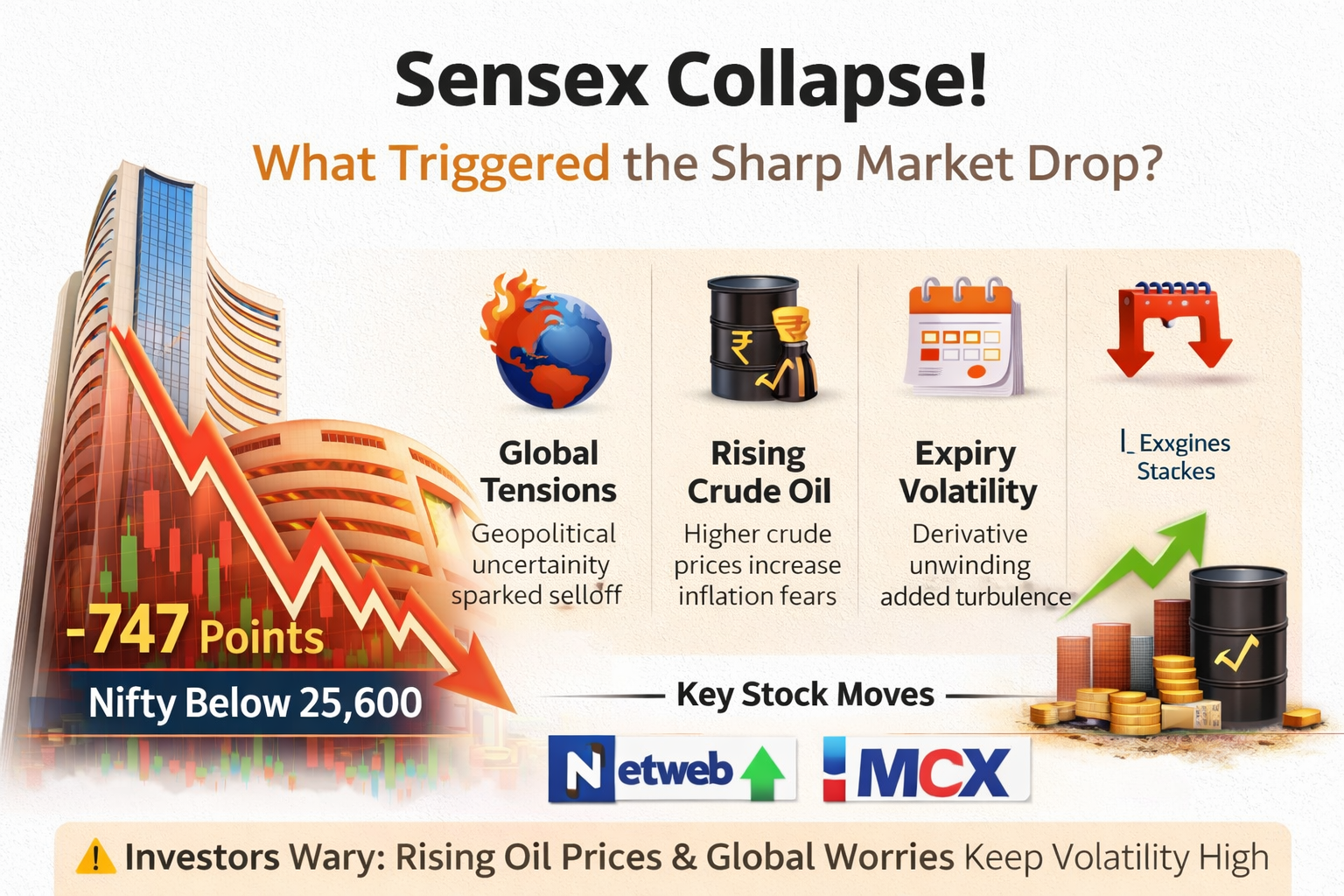
Sensex fell over 700 points
Nifty slipped below 25,600
Broader markets also saw weakness
Volatility increased sharply
This kind of fall usually feels dramatic. But markets rarely fall “without reason.”
So what triggered it?
Why Market Is Falling Today?
There isn’t just one reason. It’s usually a combination.
1️⃣ Global Tensions
When geopolitical tensions rise — especially involving major economies — investors get nervous.
Global uncertainty causes:
Risk-off sentiment
Foreign investor caution
Profit booking in emerging markets like India
Indian markets are not isolated. Global fear travels fast.
2️⃣ Crude Oil Price Impact on Indian Market
India imports most of its crude oil.
When oil prices rise:
Inflation risk increases
Government fiscal pressure rises
Rupee can weaken
Corporate margins get affected
Higher crude oil prices = higher economic pressure.
That’s why markets react quickly.
3️⃣ Derivatives Expiry Volatility
Many sharp falls happen near weekly or monthly expiry.
Traders unwind positions.
Algo trades accelerate moves.
Momentum turns extreme.
This amplifies both falls and rallies.
Stock-Specific Action: Not Everything Was Red
Even during a stock market crash in India, some stocks move differently.
📈 Netweb Share Price
Netweb showed strong gains intraday.
Possible reasons:
Business expansion optimism
AI or tech-related growth narrative
Momentum buying
Small and mid-cap tech names often behave differently from the index.
📈 MCX Stock News
MCX also gained during the fall.
Why?
Commodity volatility benefits exchanges
Higher trading activity boosts revenue
Market uncertainty increases derivatives trading
Ironically, volatility helps exchange businesses.
📉 NCC Share Latest News
NCC, however, showed weakness.
Possible triggers:
Regulatory developments
Project concerns
Sentiment-driven selling
This shows why stock selection matters more than index movement.
Why This Matters for Normal Investors
You might not trade daily.
You might be:
A SIP investor
A long-term equity holder
A beginner
So why should this concern you?
Because sharp corrections test discipline.
Markets transfer money:
From emotional investors
To patient investors
But patience doesn’t mean ignorance.
Understanding what’s happening builds confidence.
Data & Market Context
Let’s zoom out.
Historically:
5–10% corrections are normal
Markets correct multiple times every year
Bull markets include sharp temporary drops
India remains:
One of the fastest-growing large economies
Strong domestic demand driven
Supported by retail investor participation
Short-term volatility doesn’t equal long-term damage.
But risks must be acknowledged.
Pros, Cons & Risks of Current Market Situation
✅ Positives
Strong domestic participation (DIIs)
Corporate earnings still resilient
India’s macro story intact
Corrections create better entry points
⚠️ Risks
Rising crude oil prices
Persistent global tensions
FII outflows if risk aversion rises
Valuation concerns in mid/small caps
Balanced thinking prevents panic.
What Should Investors Do Now?
This depends on who you are.
👶 If You’re a Beginner
Do NOT panic sell.
Avoid fresh lump sum entry during high volatility.
Continue SIP if long-term goal exists.
Read our complete Beginner’s Guide to Stock Market Investing for fundamentals.
📊 If You’re a Long-Term Investor
Review asset allocation.
Check if portfolio is overexposed to one sector.
Use staggered buying strategy if markets correct further.
You may also want to read our recent article on How Rising Oil Prices Affect Indian Stocks.
⚡ If You’re a Trader
Respect stop-loss.
Avoid emotional revenge trading.
Volatility can be opportunity — but only with discipline.
Short-Term Outlook
Expect:
High volatility
Sharp intraday swings
Global news-driven reactions
Nifty levels around 25,600 will act as psychological support.
If broken decisively, more correction may follow.
Long-Term Outlook
India’s structural story remains intact:
Manufacturing push
Infrastructure spending
Growing digital economy
Increasing retail investor base
Corrections are part of the journey.
The question isn’t “Will markets fall?”
The real question is:
“Are you positioned to survive volatility?”
FAQ Section (SEO Optimized)
1. Why did Sensex crash today?
Sensex fell due to rising crude oil prices, global geopolitical tensions, expiry-related volatility, and heavy selling in heavyweight stocks.
2. Is this the start of a big stock market crash in India?
Not necessarily. Short-term corrections are common. A sustained crash depends on macroeconomic deterioration, which is not currently evident.
3. Why did Nifty fall below 25,600?
Selling pressure in large-cap stocks, combined with global uncertainty and volatility spikes, pushed Nifty below this key level.
4. Why did Netweb and MCX rise despite the market fall?
Company-specific momentum and business-related optimism supported these stocks. Exchanges like MCX benefit from higher volatility.
5. How do crude oil prices affect Indian markets?
Higher crude increases inflation risk, fiscal burden, and corporate costs, which negatively impacts stock valuations.
6. Should I stop my SIP during market crashes?
No. Market corrections can actually benefit long-term SIP investors by lowering average purchase cost.
7. What should beginners do during market volatility?
Stay calm, avoid panic selling, focus on asset allocation, and invest with a long-term mindset.
Final Thoughts: Calm Over Chaos
Market falls feel dramatic in the moment.
But volatility is not new.
Corrections are not rare.
Fear is not permanent.
What separates successful investors from stressed ones is not prediction —
it’s preparation.
Today’s Sensex crash is a reminder:
Markets move fast.
Discipline moves wealth.
Stay informed. Stay rational. Stay invested wisely.