Financial Analyst Career Guide – Everything a Student Must Know
Choosing the right career after Class 12 or graduation can feel confusing. If you are someone who likes numbers, business news, stock markets, and decision-making, then a Financial Analyst career can be a smart and rewarding choice.
This blog explains what a Financial Analyst is, what they do, required skills, courses, salary, colleges, future scope, and career growth—in simple language that every student can understand.
What Is a Financial Analyst?
A Financial Analyst is a professional who studies financial data and helps companies, investors, banks, or institutions make better money decisions.
In simple words, a financial analyst answers questions like:
Is this company worth investing in?
Will this project be profitable?
How can a business reduce losses and increase profits?
Financial Analysts play a key role in stock markets, companies, banks, mutual funds, and investment firms.
What Does a Financial Analyst Do?
The daily work of a financial analyst includes:
Studying company balance sheets and profit & loss statements
Analyzing stocks, mutual funds, and bonds
Tracking market trends and economic news
Preparing financial reports and forecasts
Creating Excel-based financial models
Advising companies or investors on investment decisions
Their work helps businesses grow and investors earn better returns.
Types of Financial Analyst Roles
There are many career paths within this field:
Investment Analyst
Works with stocks, mutual funds, and investment portfolios.
Equity Research Analyst
Studies companies and gives Buy / Sell / Hold recommendations.
Corporate Financial Analyst
Helps companies manage budgets, costs, and future planning.
Risk Analyst
Identifies financial risks and suggests ways to control them.
Credit Analyst
Checks whether a company or individual can repay loans.
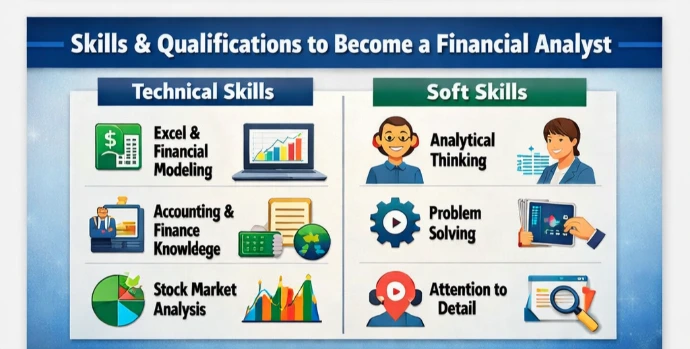
Skills Required to Become a Financial Analyst
You don’t need to be perfect in maths, but you must build these skills:
Technical Skills
Finance and accounting basics
Strong Excel knowledge
Financial analysis and modeling
Understanding of stock markets
Basic data analysis skills
Soft Skills
Logical and analytical thinking
Attention to detail
Problem-solving ability
Good communication skills
Ability to work under pressure
How to Become a Financial Analyst (Step-by-Step)
Step 1: Choose the Right Stream After Class 12
Commerce with Maths is best
Science students can also enter with extra effort
Step 2: Complete Graduation
Popular degrees:
B.Com (Finance / Accounting)
BBA in Finance
Bachelor’s in Economics
B.Sc. in Statistics or Mathematics
Step 3: Post-Graduation (Recommended)
MBA in Finance
M.Com
Master’s in Finance or Economics
Best Certifications for Financial Analysts
Professional certifications increase salary and job opportunities:
CFA (Chartered Financial Analyst)
Most respected finance certification worldwide
Best for investment and research roles
FRM (Financial Risk Manager)
Focuses on risk management and banking
NISM Certifications
Affordable and beginner-friendly (India)
Top Colleges in India for Finance
Best Colleges for Graduation
SRCC (Delhi)
St. Xavier’s College (Mumbai)
Christ University (Bangalore)
Loyola College (Chennai)
Best Colleges for MBA Finance
IIMs
XLRI
ISB Hyderabad
SP Jain
NMIMS
Financial Analyst Salary in India
Fresher Salary
₹4 to ₹8 LPA
Mid-Level Experience (3–6 years)
₹10 to ₹18 LPA
Senior Level (7+ years)
₹20 to ₹40+ LPA
Salary depends on skills, certifications, company, and location.
Career Growth & Future Opportunities
With experience, a financial analyst can become:
Senior Financial Analyst
Portfolio Manager
Investment Banker
Finance Manager
Chief Financial Officer (CFO)
The future scope of financial analysts is very strong, especially with the growth of stock markets, startups, and global investments.
Pros and Cons of Financial Analyst Career
Advantages
High salary potential
Strong demand in India and abroad
Professional and respected career
Continuous learning and growth
Challenges
Competitive field
High pressure during market volatility
Requires constant skill upgrading
Who Should Choose This Career?
This career is ideal if you:
Enjoy numbers and data
Follow business or stock market news
Like problem-solving
Want a corporate or finance career
Are disciplined and detail-oriented
Final Advice for Students
If you want to become a Financial Analyst:
Build strong finance basics
Learn Excel and financial tools early
Do internships during college
Follow financial news daily
Invest time in certifications like CFA
This career rewards knowledge, consistency, and smart thinking.
SEO Keywords Used Naturally:
Financial Analyst career, Financial Analyst salary in India, how to become a Financial Analyst, finance career after 12th, CFA course details, finance jobs in India, career in finance, investment analyst
If you want, I can also:
Add FAQs for SEO
Create meta title & description
Shorten it for website footer
Create a cover image
Convert it into PDF or Word format
Just tell me what you need next 🚀
ND SOMEE FAQ WITH DETAIL EXPLANATION
Perfect 👍
Below are SEO-friendly, detailed FAQs written in simple, human language. You can directly add these to the end of your blog to improve Google ranking and student engagement.
Frequently Asked Questions (FAQs) – Financial Analyst Career
1. Is Financial Analyst a good career option in India?
Yes, becoming a Financial Analyst is a very good career option in India, especially for students interested in finance, stock markets, and business analysis. With the growth of startups, mutual funds, stock markets, and corporate finance, the demand for skilled financial analysts is increasing every year. The career offers good salary, job stability, and long-term growth opportunities.
2. What qualifications are required to become a Financial Analyst?
To become a Financial Analyst, you usually need:
A bachelor’s degree like B.Com, BBA (Finance), Economics, or Statistics
A postgraduate degree like MBA in Finance is highly preferred
Professional certifications such as CFA, FRM, or NISM increase job chances and salary
Commerce students with maths have an advantage, but science students can also enter this field.
3. Can I become a Financial Analyst after Class 12?
You cannot directly become a Financial Analyst after Class 12, but you can start preparing early. After Class 12, choose the right graduation course in finance or commerce. During college, you should learn Excel, financial basics, and do internships. With proper education and skills, you can enter this field after graduation or post-graduation.
4. Is maths compulsory to become a Financial Analyst?
You don’t need advanced or very high-level maths, but basic maths and logical thinking are important. Most of the work involves understanding numbers, percentages, ratios, and trends. If you are comfortable with basic maths and analysis, you can easily succeed as a Financial Analyst.
5. What is the difference between a Financial Analyst and a Chartered Accountant (CA)?
A Financial Analyst focuses more on investment analysis, business decisions, and market research.
A Chartered Accountant (CA) focuses on accounting, auditing, taxation, and compliance.
Both are good careers, but Financial Analysts work more in stock markets, corporate planning, and investments, while CAs work more in accounting and legal finance roles.
6. Is CFA necessary to become a Financial Analyst?
CFA is not compulsory, but it is highly recommended. The CFA (Chartered Financial Analyst) certification is globally respected and improves your knowledge, credibility, and salary. Many top finance and investment roles prefer candidates with CFA qualification, especially in equity research and portfolio management.
7. How long does it take to become a Financial Analyst?
On average, it takes:
3 years for graduation
2 years for post-graduation (MBA Finance)
So, around 5–6 years of education. If you pursue CFA, it may take additional time, but you can study for it alongside your job.
8. What is the starting salary of a Financial Analyst in India?
The starting salary of a Financial Analyst in India usually ranges from ₹4 to ₹8 lakhs per year. Salary depends on your skills, education, certifications, and the company you join. Candidates with CFA Level 1 or good internships often earn more than freshers.
9. Can Financial Analysts work abroad?
Yes, Financial Analysts have strong international career opportunities. Countries like the USA, UK, Canada, Singapore, and Dubai offer high-paying finance roles. Global certifications like CFA help a lot if you want to work abroad.
10. Is Financial Analyst a stressful job?
The job can be stressful at times, especially during market volatility, deadlines, or major financial decisions. However, with experience and good time management, most professionals learn to handle the pressure well. The high salary and growth often balance the stress.
11. What skills should I learn during college to become a Financial Analyst?
During college, focus on:
Advanced Excel
Financial statement analysis
Basic stock market knowledge
Financial modeling
Communication and presentation skills
Reading business and financial news daily
These skills help you stand out during placements.
12. Is Financial Analyst better than MBA Finance?
A Financial Analyst is a job role, while MBA Finance is a degree. An MBA Finance can help you become a Financial Analyst. Many Financial Analysts hold an MBA in Finance along with certifications. Both are connected and complement each other.
13. Are internships important for becoming a Financial Analyst?
Yes, internships are extremely important. They give you real-world experience, practical knowledge, and improve your resume. Many students get full-time jobs from their internships itself.
14. What is the future scope of Financial Analysts?
The future scope is very strong. With increasing investments, data-driven decision-making, and global business expansion, skilled Financial Analysts will always be in demand. Analysts who combine finance with technology and data skills will have the best career growth.
15. Who should avoid becoming a Financial Analyst?
This career may not be suitable if you:
Dislike numbers or data
Prefer creative or artistic careers
Cannot handle deadlines or pressure
Are not interested in continuous learning