
Why this matters
After more than 50 years since humans last left Earth to orbit the Moon with a crew, NASA is getting ready to send astronauts back into deep space again. The giant Artemis II rocket has just been moved into position for launch — a huge milestone that reminds us that human space exploration hasn’t stopped, even if it has felt quiet for decades. (Reuters)
🚀 What’s Happened So Far
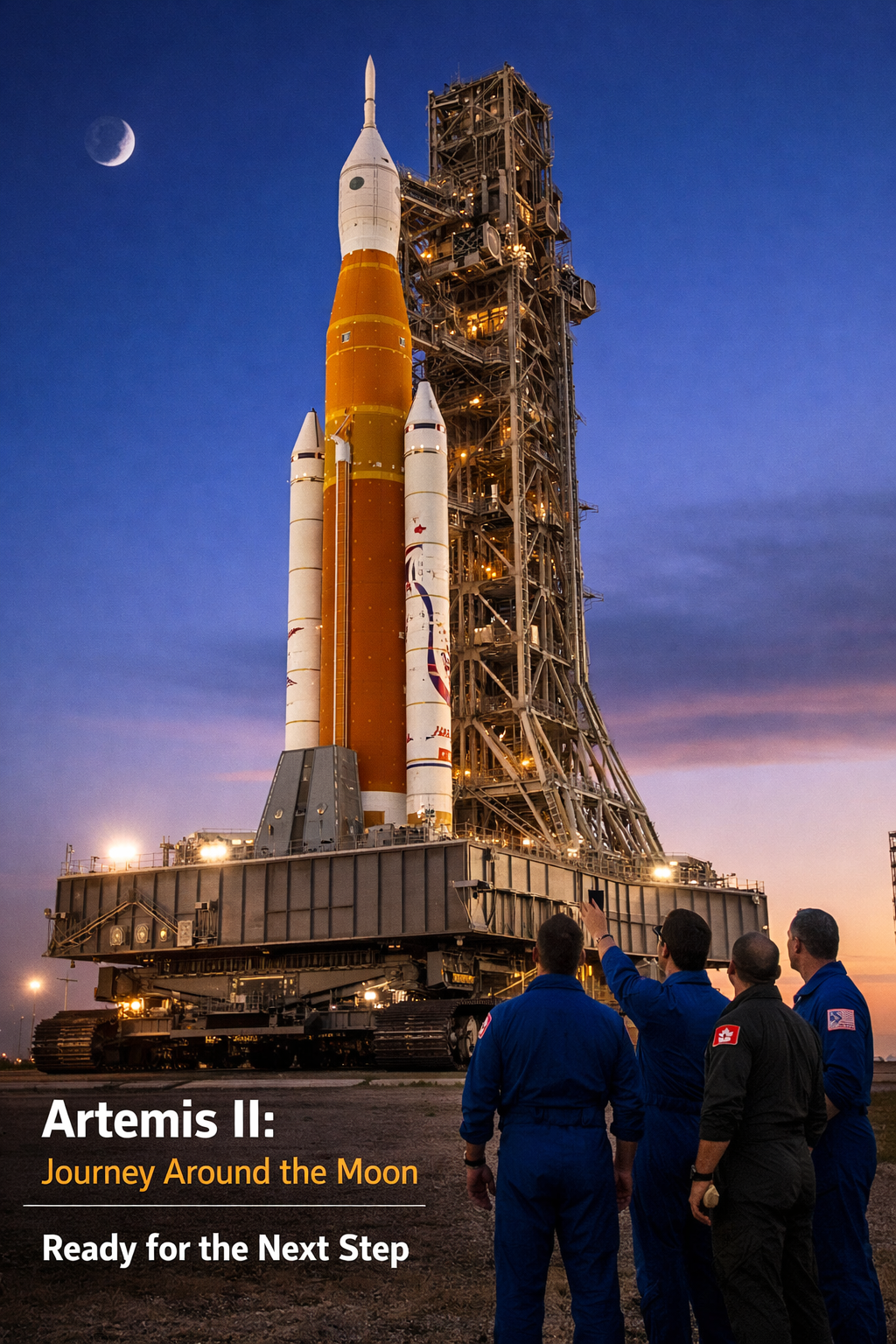
NASA has completed a slow, carefully planned move of its massive Artemis II rocket from the assembly building to the launch pad at the Kennedy Space Center in Florida. This wasn’t a sprint — the rocket rolled just a few kilometres over roughly 10–12 hours, at a pace of about one mile per hour, balanced on a special crawler transporter built for heavy loads. (Space)
Picture a skyscraper on wheels inching along a road — that’s how big and slow this move was. The rocket and the Orion spacecraft on top of it now stand at Launch Pad 39B, where the final preparations for launch will happen. (NASA)
🧠 Explanation
Think about getting ready for a big event like a wedding. You don’t just show up at the venue — you move all the furniture, sound equipment, lights, and stage props into place first, then test the microphone, the music, and the decorations before the guests arrive.
That’s what NASA is doing now: moving the rocket into position and then running lots of tests to make sure everything works perfectly before “guests” — in this case astronauts — get aboard.
This rocket isn’t just any machine. It’s hundreds of feet tall, millions of kilograms heavy, and built to carry people farther than humans have traveled in more than half a century. Each step has to be slow, careful, and safe. (The Guardian)
🎯 What the Artemis II Mission Actually Is
Here’s the key thing to understand:
This is not a moon landing — yet.
The Artemis II mission will send a crew of four astronauts around the Moon and back, without touching down on the lunar surface. (NASA)
The goal is to test life-support systems, navigation, and other equipment while the spacecraft makes the round trip. This is part of a staged approach to returning humans to the Moon. (NASA)
Later missions — like Artemis III — are being prepared to land on the Moon’s surface, possibly as soon as 2027. (Wikipedia)
In everyday terms, Artemis II is like a “dress rehearsal with actors” before the actual performance of returning humans to walk on the Moon again.
🧑🚀 Who’s Going
Four astronauts — three from NASA and one from the Canadian Space Agency — will be aboard this mission. They’ll spend about 10 days in space, travelling around the Moon and then back to Earth. (Space)
That’s a long trip — roughly 685,000 miles — and it’s not just for fun. NASA will be testing how well the spacecraft operates when humans are inside, including life support and communication systems. (The Guardian)
🛠Behind the Scenes: Tests and Preparations
Now that the rocket is at the pad, engineers won’t just fire it up and go. They need to go through essential checks, including something NASA calls a “wet dress rehearsal.” That’s where the rocket’s fuel tanks are filled, and a practice countdown is run — without actual astronauts — to make sure everything works exactly as it should. (Space)
If something doesn’t go right there, NASA can even roll the rocket back into its building for more work. This might sound dramatic, but it’s how space missions always happen: slow, careful steps. (Space)
💡 What It Means for Ordinary People
You might wonder, “Why should I care about a rocket going to the Moon?”
Here’s why it resonates:
Science and technology progress: These missions push the boundaries of what’s possible, and the innovations often find their way into things we use every day.
Inspiration: Space exploration captures imaginations and encourages students around the world — including in India — to pursue science, engineering, and innovation.
Global cooperation: International participation (like Canada’s astronaut and others in later missions) shows that space exploration brings countries together. (Wikipedia)
For most people, this mission won’t change daily life overnight — but it does keep alive humanity’s broader journey into space and our shared curiosity about the universe.
🧘♂️ No Need to Panic
There’s nothing here to be worried about:
There’s no immediate effect on normal life or the economy because of this mission.
Delays are possible — space missions often change timelines — and that’s normal. NASA prioritises safety and success over rushing. (Space)
This isn’t about any kind of threat or crisis — it’s about exploration and careful engineering.
🛑 But Here’s What Not to Misunderstand
This mission isn’t a Moon walk — it’s a lunar loop test flight.
It won’t make space travel suddenly cheap or routine — space is still very hard, slow, and expensive.
It won’t directly boost your smartphone or electricity bill tomorrow.
🧡 Calm Conclusion: What’s Happening Next
Right now, NASA’s Artemis II rocket is sitting at its launch pad, and teams are moving into the final phase of preparation. In the coming days and weeks, they’ll check every detail, rehearse countdowns, and make sure everything is safe before locking in a launch date — possibly as early as early February 2026. (Reuters)
This moment — a rocket poised for a human journey around the Moon — is a reminder that human space exploration continues to advance, step by careful step. It ties us to the past (the Apollo era) and points to the future (returning to the Moon’s surface and beyond).
That’s something worth watching — but not panicking about — as space technology grows and evolves.