
When economic headlines mention numbers like “$25 billion trade deficit”, it can feel abstract and worrying at the same time.
But this topic matters because trade numbers quietly affect things like currency movement, import prices, and long-term economic stability — even if we don’t notice it day to day.
So let’s understand what really happened in December, without panic and without complicated language.
First, a quick refresher: what is a trade deficit?
A trade deficit simply means:
A country buys more goods from the world than it sells to the world.
In December:
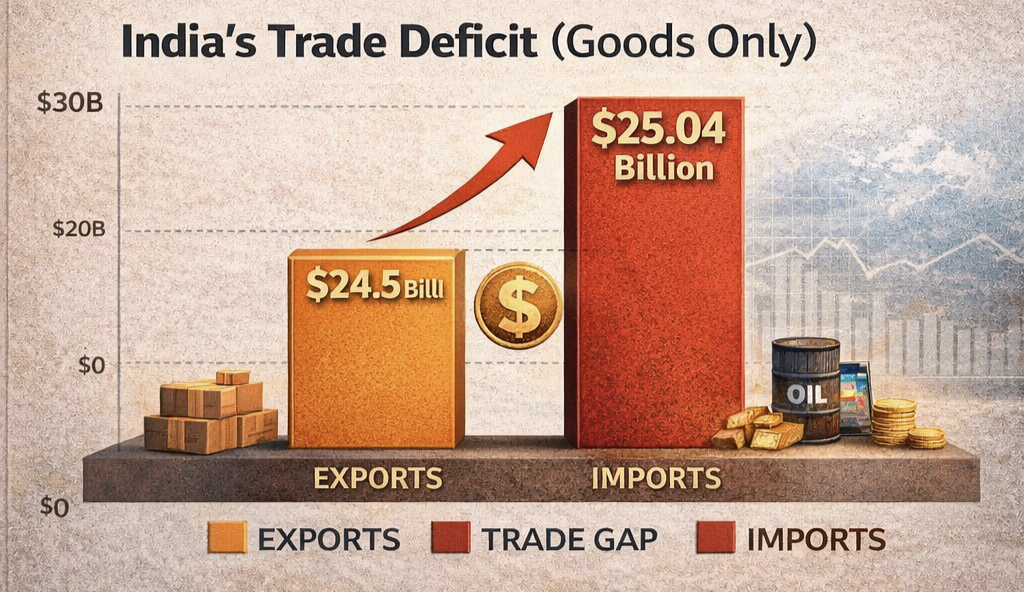
India exported goods worth around $38.5 billion
India imported goods worth about $63.5 billion
The gap between the two was $25.04 billion.
That gap is called the trade deficit.
Why did the trade deficit increase in December?
The increase didn’t happen because exports suddenly collapsed.
It happened mainly because imports grew faster than exports.
1. Imports stayed high
India continues to import:
Crude oil and energy products
Electronics and machinery
Industrial raw materials
Gold and other commodities
In December, the total import bill crossed $63 billion, which is relatively high.
Higher global prices and year-end demand both played a role.
2. Exports grew, but slowly
Exports were not weak, but they weren’t strong enough to balance imports.
Merchandise exports were around $38.5 billion
That was only about 2% higher than last year
Global demand remains cautious:
Europe is still slowing
China’s recovery is uneven
US demand is selective
So Indian exporters are selling — just not aggressively.
3. November was unusually low
In November, India’s trade deficit had dropped to about $24.5 billion, the lowest level in five months.
December looks bigger partly because November was relatively calmer.
This makes the jump look sharper than it actually is.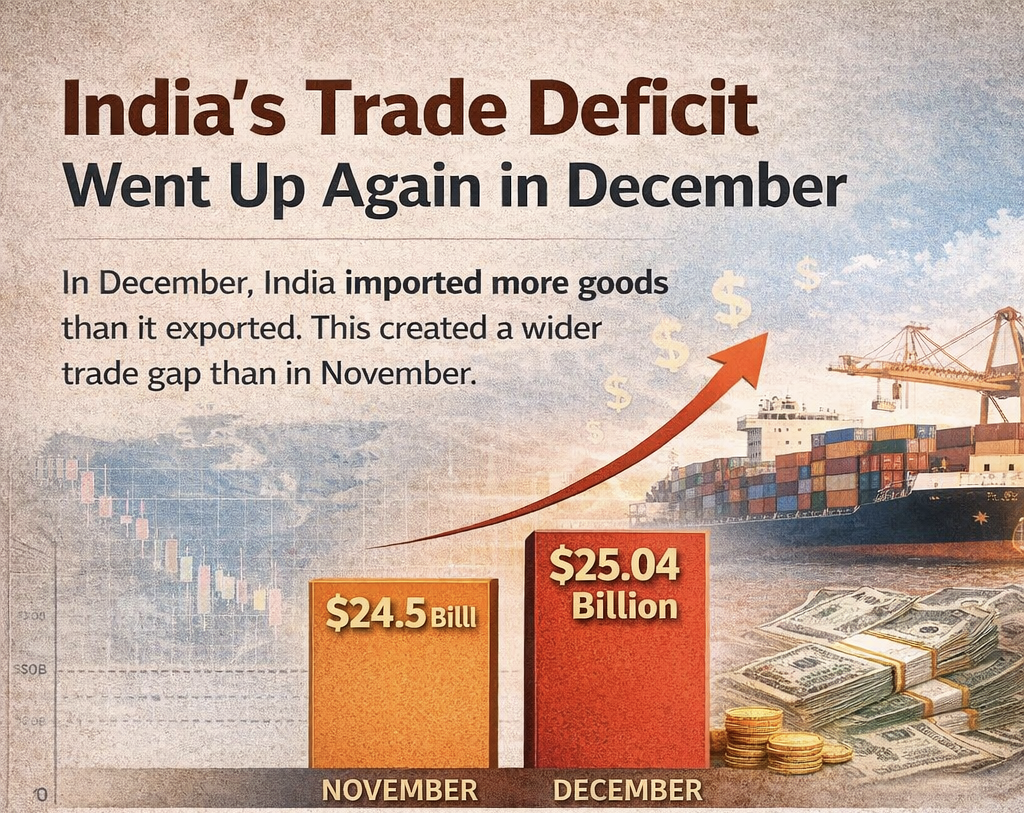
What’s happening behind the scenes (important context)
One thing headlines often miss:
India earns heavily from services, not just goods.
In December:
Services exports (IT, consulting, business services) were about $35.5 billion
Services imports were roughly $17.4 billion
That creates a services surplus of over $18 billion
This services income helps offset the goods trade deficit.
So while goods trade shows a gap, the overall external position is more balanced than it appears.
How does this affect normal people?
For most households, the effect is indirect, not immediate.
Possible mild impacts:
Imported goods may stay expensive
Fuel prices remain sensitive to global oil trends
The rupee may feel mild pressure if deficits stay high for many months
What is unlikely:
No sudden inflation spike
No immediate job impact
No emergency economic measures
This is not a shock situation — it’s a monitoring situation.
What does this mean for investors?
For investors, this data is more about trend-watching, not reaction.
Things that matter more than one month:
Whether exports recover over the next quarter
Crude oil price direction
Rupee stability
Global demand improvement
A single month’s trade gap does not change India’s long-term growth outlook.
Markets usually care about patterns, not headlines.
What people should NOT panic about
Let’s clear some common fears:
❌ This does not mean India is facing a crisis
❌ This does not mean foreign money is running away
❌ This does not mean the economy is slowing sharply
❌ This does not signal policy failure
Trade deficits move up and down — especially in large, growing economies.
What is worth calmly watching
Without fear, these are reasonable things to keep an eye on:
Export performance in early 2026
Oil price movement
Global economic recovery
Rupee movement
These indicators together matter far more than one data point.
The bigger picture
From April to December of the current financial year, India’s total exports have crossed $630 billion.
That tells us something important:
India is still trading actively with the world — buying what it needs and selling what it can, in a challenging global environment.
December’s trade deficit is a data signal, not a danger signal.
Final thoughts
A $25 billion trade deficit sounds large — but numbers need context.
What December really shows is:
Strong domestic demand
Steady but cautious exports
A global economy that is still uneven
For most people, the right response is not worry — just understanding.
Clarity matters more than headlines.