DAX Ends Higher, but 2026 Remains a Test of Patience for German Markets
German equities closed the session on a positive note, with the DAX managing to edge higher as investors weighed short-term optimism against long-term uncertainty. While the headline numbers looked encouraging, the broader mood across European markets remained cautious rather than confident.
At first glance, the rise in the DAX suggests renewed interest in German stocks. Export-oriented companies, industrial majors, and select technology firms helped lift the index as investors reacted to easing inflation pressures and expectations that monetary policy may become less restrictive over time. For many traders, this was enough to justify selective buying toward the close of trade.
However, beneath the surface, the market story is far more complex.
Economic Hopes Are Real — But Fragile
Germany’s economy is slowly showing signs of stabilization after a challenging period marked by weak industrial output, sluggish consumer demand, and rising costs. Any hint of recovery naturally feeds optimism in equity markets. Expectations of improved global trade conditions and a gradual rebound in manufacturing have also supported sentiment.
That said, these hopes remain fragile. Growth forecasts for 2026 are modest, and businesses are still adjusting to higher financing costs compared to the ultra-low-rate era of the past decade. Investors appear willing to stay invested, but not yet convinced enough to take aggressive risks
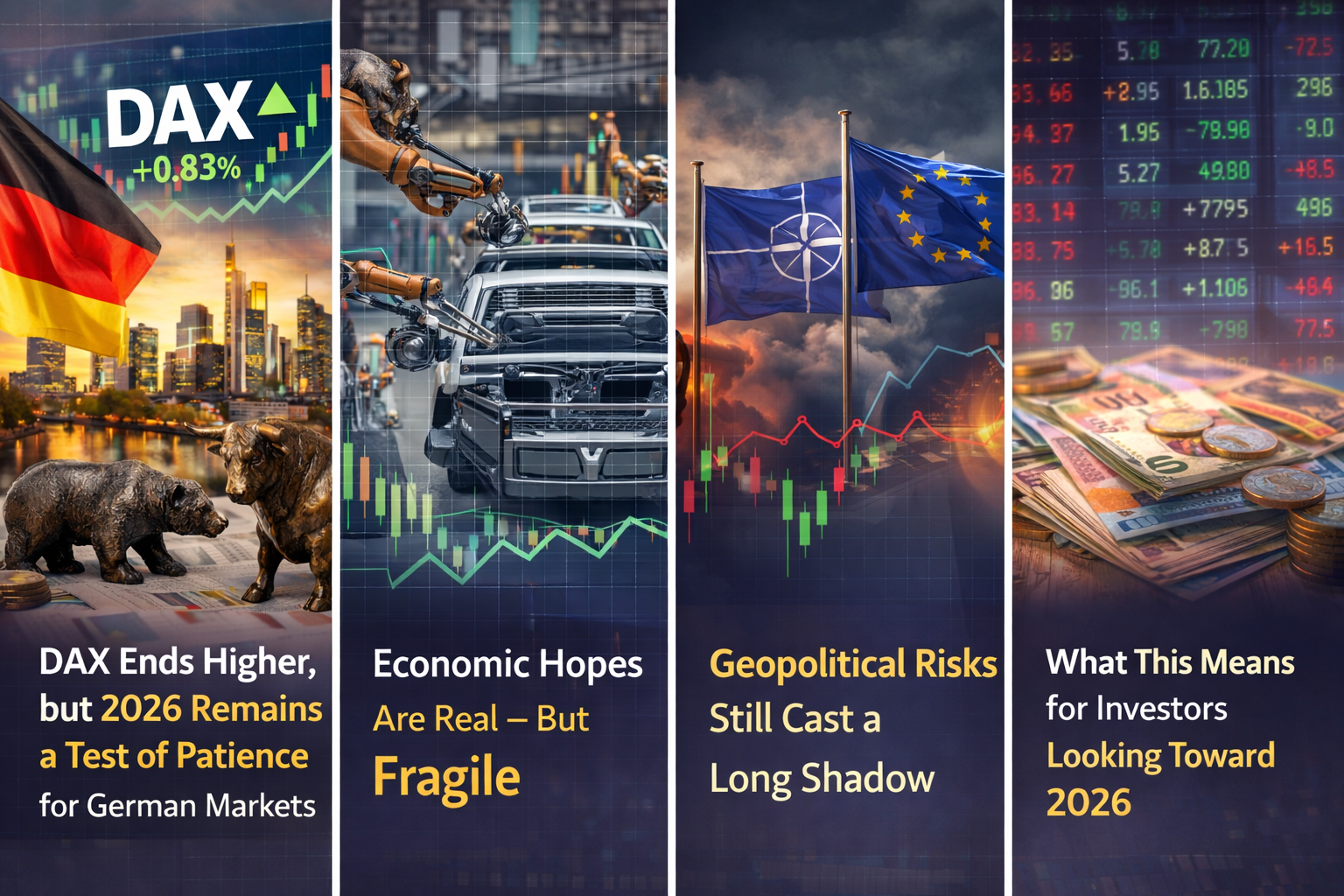
Geopolitical Risks Still Cast a Long Shadow
While economic indicators offer some relief, geopolitical tensions continue to limit upside potential for the DAX. Global trade disruptions, ongoing regional conflicts, and political uncertainty across key markets remain powerful risk factors.
Germany’s heavy reliance on exports makes it particularly sensitive to international instability. Any escalation in global tensions or renewed supply-chain disruptions could quickly reverse market gains. This reality is keeping long-term investors cautious, even on days when the index finishes in the green.
What This Means for Investors Looking Toward 2026
The DAX appears to be entering a phase where progress will likely be slow and uneven rather than explosive. Short-term rallies may continue, especially on supportive data or policy signals, but sustained momentum will depend on clearer economic recovery and a calmer global backdrop.
For investors, 2026 may not be about chasing fast returns but about discipline, diversification, and realistic expectations. German equities still offer strong fundamentals in many sectors, but patience may be the most valuable asset in the years ahead.
Final Takeaway
The DAX closing higher reflects cautious optimism, not a full-scale comeback. Germany’s market is balancing hope with hesitation — moving forward, but carefully. As 2026 approaches, investors would be wise to focus less on daily moves and more on long-term resilience in an increasingly uncertain world.