Bachelor of Business Administration (BBA):
After Class 12, many students want a course that builds leadership, management, and business skills. One of the best options for such students is BBA (Bachelor of Business Administration). This blog is a complete career counseling guide on BBA, written in simple, practical language to help students and parents make the right decision.
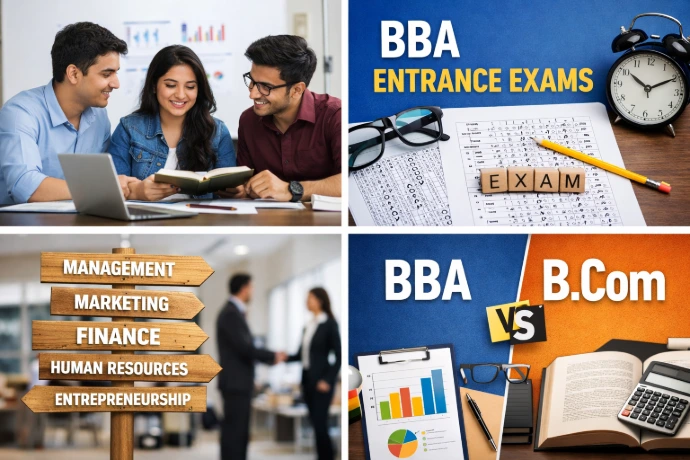
Bachelor of Business Administration (BBA): Complete Career Counseling Guide
Last updated: 22/12/2025
What is BBA?
BBA (Bachelor of Business Administration) is a 3-year undergraduate degree focused on management, business operations, leadership, and entrepreneurship. It prepares students for corporate roles, startups, and higher management studies like MBA.
BBA is ideal for students who want to:
Work in corporate management
Start their own business
Build leadership and decision-making skills
Pursue MBA or international management programs
Types of BBA Courses
1. BBA General
Covers all core management subjects
Best for students who want overall business knowledge
2. BBA with Specialization
Popular specializations include:
BBA in Marketing
BBA in Finance
BBA in Human Resource Management (HR)
BBA in International Business
BBA in Entrepreneurship
BBA in Operations & Supply Chain
👉 Choose a specialization based on your interest and future career plan.
Eligibility Criteria for BBA
Must have passed Class 12 from a recognized board
Students from any stream (Commerce / Science / Arts) can apply
Minimum marks usually range between 45% – 60% (varies by college)
Mathematics is helpful but not compulsory for all colleges
Most Popular Entrance Exams for BBA (Explained Simply)
Many top colleges and universities conduct entrance exams for admission to BBA. These exams test a student’s basic aptitude, logical thinking, English, and general awareness.
1️⃣ CUET (Common University Entrance Test)
Conducted by: NTA (National Testing Agency)
Accepted by: Central Universities like Delhi University, BHU, Jamia, etc.
Subjects tested: English, General Test, Domain subjects
Level: Moderate
👉 CUET is currently the most important entrance exam for BBA in India.
2️⃣ IPMAT (Integrated Program in Management Aptitude Test)
Conducted by: IIM Indore, IIM Rohtak, IIM Jammu
Course offered: 5-year Integrated BBA + MBA
Subjects tested: Quantitative Ability, Verbal Ability, Logical Reasoning
Level: Difficult
👉 Best for students aiming for IIM-level management education.
3️⃣ SET (Symbiosis Entrance Test)
Conducted by: Symbiosis International University
Accepted by: Symbiosis colleges across India
Subjects tested: English, Quantitative Aptitude, Logical Reasoning, General Awareness
Level: Moderate
4️⃣ NPAT (NMIMS Programs After Twelfth)
Conducted by: NMIMS University
Accepted by: NMIMS campuses (Mumbai, Bengaluru, etc.)
Subjects tested: Quantitative & Numerical Ability, Reasoning, English
Level: Moderate
5️⃣ AIMA UGAT
Conducted by: AIMA (All India Management Association)
Accepted by: Many private colleges
Subjects tested: English, Maths, Reasoning, General Knowledge
Level: Easy to Moderate
6️⃣ Christ University Entrance Test
Conducted by: Christ (Deemed to be University)
Includes: Entrance test + Interview + Skill assessment
Focus: Communication, aptitude, confidence
Common Subjects Asked in BBA Entrance Exams
English Language
Quantitative Aptitude (basic maths)
Logical Reasoning
General Awareness
Admission Process
Entrance exams (common for top colleges)
Merit-based admission in some universities
Group discussion (GD) and personal interview (PI) may be required
Fee Structure (Approximate):
Government colleges: ₹20,000 – ₹60,000 per year
Private colleges: ₹80,000 – ₹3,00,000 per year
Subjects Taught in BBA
Common subjects across most universities:
Principles of Management
Business Economics
Financial Accounting
Marketing Management
Human Resource Management
Organizational Behaviour
Business Law
Operations & Supply Chain Management
Entrepreneurship Development
Business Communication
These subjects focus on practical business skills rather than only theory.
Skills Required for BBA Students
To succeed during and after BBA, students should develop:
Leadership and teamwork
Communication & presentation skills
Decision-making ability
Analytical thinking
Time management
Basic finance & Excel skills
Skills matter more than marks in management careers.
Career Options After BBA
Job-Oriented Career Options
After completing BBA, students can work as:
Management Trainee
Business Development Executive
Marketing Executive
HR Executive
Operations Executive
Sales Manager (Entry-level)
Startup Associate
Starting Salary: ₹3 – 6 LPA (depends on college, skills & role)
Higher Studies After BBA
Most Popular Option:
MBA (Master of Business Administration) – Highly recommended
Other Options:
PGDM
MMS
International MBA
M.Sc in Management / Business Analytics
BBA + MBA is one of the strongest combinations for corporate careers.
Professional & Certification Courses
To enhance career growth, students can pursue:
Digital Marketing certifications
Data Analytics & Business Analytics
Project Management (PMP)
Supply Chain Management courses
International certifications
Government Job Opportunities After BBA
BBA graduates are eligible for:
Banking exams (IBPS, SBI, RBI)
SSC & State government exams
UPSC (after graduation)
PSU exams (with additional qualifications)
Scope of BBA in India & Abroad
In India:
High demand in corporate sector, startups, MNCs
Growth depends on MBA and skills
Abroad:
BBA + MBA opens global management roles
Popular countries: USA, Canada, UK, Australia
Advantages of BBA
Strong foundation in management
Early exposure to corporate culture
Best preparation for MBA
Suitable for entrepreneurs
Limitations of BBA
Limited growth without MBA
Higher fees compared to B.Com
Competitive job market
BBA vs B.Com (Quick Comparison)
| Aspect | BBA | B.Com |
|---|---|---|
| Focus | Management & Leadership | Accounting & Finance |
| Best for | MBA, Corporate roles | CA, CMA, Finance |
| Salary Start | Higher | Moderate |
| Practical Exposure | High | Moderate |
Is BBA Right for You?
Choose BBA if you:
Want a career in management or business
Like leadership and teamwork
Plan to do MBA
Avoid BBA if you:
Want deep accounting & finance knowledge
Prefer professional courses like CA
Final Conclusion
BBA is an excellent career-oriented degree for students interested in business and management. However, real success comes from:
Skill development
Internships
Higher studies like MBA
With the right planning, BBA can lead to high-paying leadership roles.
This career counseling guide is for educational purposes only to help students make informed career decisions.